
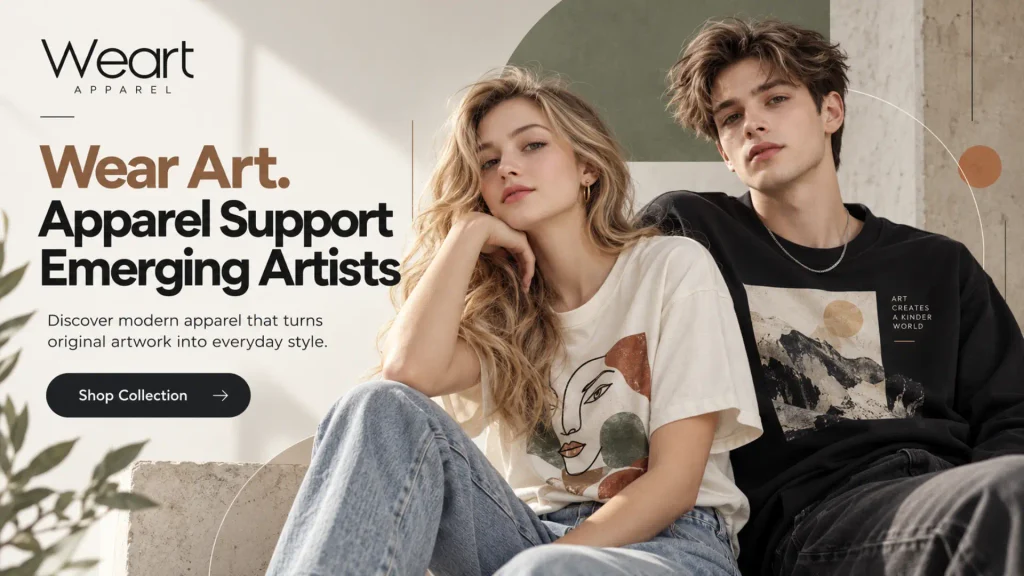
Wear Art. Apparel Support Emerging Artists
Weart Apparel was founded in 2018 with a simple idea: art should not be limited to galleries, studios, exhibitions, or digital screens. Clothing can also become a place where creative work is seen, carried, and discovered. By bringing original artwork onto apparel and other physical products, Weart created another way for emerging artists to reach people outside traditional art spaces. A shirt could become more than an everyday item; it could function as a moving canvas that introduces an artist’s work wherever the person wearing it goes. From the beginning, the project focused not only on the visual design of the product but also on the person who created the artwork, making the relationship between artist, artwork, and audience an important part of the brand.
During its early development, Weart regularly featured artists, shared information about their creative work, and transformed selected pieces into products people could wear, carry, or display. The project worked with different forms of visual art rather than following one fixed style, giving space to illustration, photography, printmaking, digital art, and other creative approaches. By late 2019, more than 260 shirts had been sold, while the project’s audience was estimated at approximately 5,000 people. These figures represent a specific period in Weart’s early history rather than current business statistics, but they show how the concept developed from a small creative project into a platform with a real audience and a growing network around art and apparel.
Contents
Clothing as a Moving Canvas
One of the central ideas behind Weart Apparel is that clothing can function as a mobile canvas. Traditional artwork is often experienced in a fixed location: a painting may remain inside a gallery, a print may hang on a wall, and a photograph may be shown during an exhibition. Apparel creates a different type of visibility because it moves with the person wearing it. Artwork printed on a shirt can appear on a campus, in a café, on a city street, at an event, or in any other part of everyday life. This movement gives the artwork repeated opportunities to be noticed by people who may never have encountered the artist through a gallery or formal exhibition. For Weart, the product was therefore not simply a surface for decoration. It was a practical way to bring original creative work into public spaces while keeping the artist connected to the design.
Creating More Visibility for Emerging Artists
Weart developed from founder Torsten Brinkema’s interest in helping young and emerging artists gain greater exposure. While studying studio art, Brinkema encountered talented creators whose work did not always have an easy route to a broader audience. Established artists may already have gallery representation, collectors, media attention, professional networks, or large online followings, while artists at an earlier stage of their careers often have fewer opportunities to place their work in front of new people. Weart was created as one additional channel for that discovery. By featuring artwork on physical products and introducing the artist behind each design, the project gave creators another way to move their work beyond studios and classrooms and into everyday environments where new audiences could encounter it naturally.
More Than a Graphic T-Shirt
Although T-shirts were an important part of Weart’s original identity, the broader concept was never limited to one type of apparel. As the project developed, artwork also appeared on other products, including canvas bags and posters. This expansion followed the same basic idea: original artwork can exist in different formats and reach people in different settings. A poster places an artist’s work inside a home or personal space, while a bag or shirt allows the artwork to travel through daily life. The meaning behind the Weart name also reflected this development. The original interpretation of “Wear Art” directly described the idea of putting artwork on clothing, while the broader idea of “We Art” represented an interest in building connections between artists, audiences, products, and creative communities. The product remained important, but the larger identity of the project was connected to the people behind the work.
The Artist Behind the Design Matters
An important part of Weart’s approach was making sure the artwork was not separated from its creator. In many retail environments, customers may see a graphic they like without ever learning who designed it, what influenced the work, or where it came from. Weart approached the experience differently by giving attention to the artist as well as the finished design. This allowed customers to understand that the image on a shirt or poster was not simply an anonymous graphic, but the result of an individual creative process. That context can change the way someone experiences a product because it creates a direct link between the object and the person who made the artwork. For an emerging artist, even a small interaction can become part of a larger process of discovery, as someone who first encounters the work through apparel may later become interested in seeing more of the artist’s portfolio or following their future work.
Sharing Value With Participating Artists
Supporting artists was also reflected in Weart’s early business model. During the project’s initial development, participating artists received a percentage of the profit associated with products featuring their work. The documented artist share began at 10 percent and was later increased to 15 percent. These percentages refer to Weart’s historical model and should not automatically be treated as its current compensation structure, but they are significant because they show that the idea of supporting artists extended beyond exposure alone. The creative work contributed directly to the value of the product, and the artist was included financially when that product generated profit. This approach recognized that artwork represents time, skill, experimentation, and creative labor, while also reinforcing Weart’s identity as a project designed around collaboration with artists rather than simply using artwork as decoration.
From Minneapolis Roots to a Wider Creative Community
Weart Apparel has roots in Minneapolis, Minnesota, while an important period of its early development also took place during Brinkema’s time at Colby College in Maine. The project grew while its founder was still a student, which meant that many parts of the operation developed on a relatively small entrepreneurial scale. Products were photographed, promoted, prepared, and shipped while Weart continued building its identity and relationships with artists. By late 2019, more than 260 shirts had been sold, and the project’s audience was estimated at around 5,000 people. Those numbers belong to a specific stage in Weart’s history, but they demonstrate that the idea had already developed beyond a concept. Artists were being featured, products were being created, customers were buying them, and a community was beginning to form around the connection between art and apparel.
Wear the Work. Discover the Artist.
At its core, Weart Apparel connects the creator, the artwork, and the person who chooses to wear or own it. The physical product provides a format, but the artwork begins with an artist, and that relationship remains central to the concept. When an original work appears on a shirt, poster, or other object, it gains another opportunity to move outside its original setting and become part of everyday life. Someone may first notice the visual design, then learn about the creator behind it, discover additional work, or introduce that artist to someone else. In this way, the product can become a starting point for discovery rather than the end of the experience.
Since its beginning in 2018, Weart’s early development showed how art, apparel, storytelling, and entrepreneurship could intersect while keeping the artist visible. The project expanded from T-shirts into other formats, worked with creators from different artistic disciplines, and developed a model that combined audience exposure with financial participation for featured artists. Its early sales and audience figures provide a snapshot of that growth, but the larger idea remains more important than the numbers: artwork can exist in more places than traditional galleries, and everyday objects can become another way for creative work to reach people. A shirt can be practical, a poster can decorate a room, and a bag can carry personal belongings, but each can also carry an artist’s work into spaces where it may be seen for the first time. That connection between everyday life and creative expression is the foundation of Weart Apparel.
1. What is Weart Apparel?
Weart Apparel is a creative clothing brand founded in 2018 that features original artwork by emerging artists on T-shirts and other products. The brand aims to make art more accessible through everyday fashion.
2. What products does Weart Apparel offer?
Weart Apparel has featured a variety of products, including graphic T-shirts, canvas bags, and posters. Each product showcases original artwork created by participating artists.
3. How does Weart Apparel support emerging artists?
Weart Apparel supports emerging artists by showcasing their artwork on physical products, promoting their creative work, and helping them reach wider audiences. Historically, participating artists also received a percentage of the profits from products featuring their designs.