
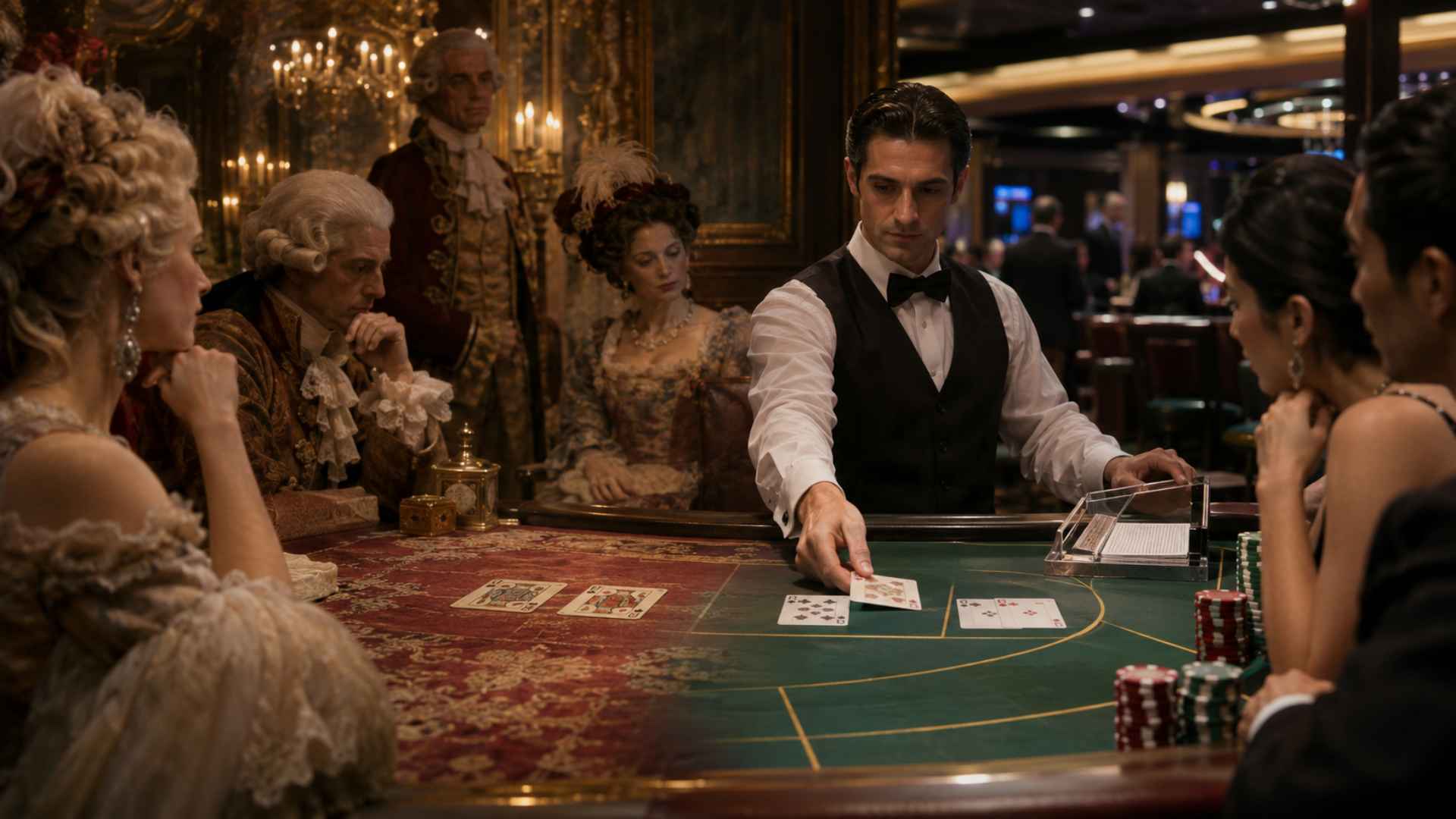
Baccarat did not arrive at its modern rules all at once. The present day procedure grew from older versions in which people, rather than fixed drawing charts, made important choices. Compared with a slot machine, the appeal of those tables included direct involvement in the deal. Yet that involvement also created disputes and operational complications. Over time, casinos favored rules that produced consistent rounds, settled quickly, and could be taught without lengthy negotiations.
Earlier baccarat banque used two player hands against a banker’s hand. The banker could remain in that position for an extended stretch, while different participants represented the two opposing sides. Later chemin de fer reduced the contest to a banker and one player hand, with the bank passing around the table. These versions shared familiar scoring but differed in decision rights, table structure, and the way money moved between participants.
In all major variants, card values form the stable core. Aces count one, cards two through nine keep their face value, and tens and picture cards count zero. Only the units digit matters if the total exceeds nine. Someone holding seven and eight therefore has five, not fifteen. That simple arithmetic survived the move from participant banked games to modern house banked formats, making successive changes easier for regular players to recognize.
Banque and Chemin de Fer at the Table
In banque, a banker faced two separate player hands and could exercise considerable judgment. Chemin de fer offered a different arrangement: the bank typically rotated, and the active participants retained decisions about drawing. Those decisions were not unrestricted, but they made the play less automatic than today’s common format. The bank was also a financial position occupied by a customer, not simply the label on a casino betting area.
The question of Banker or Player took on a different meaning when the house later became the permanent financial counterparty. Modern tables frequently display a Player Bet and a Banker Bet as separate choices, but such wagers should not be projected backward onto every European predecessor. In chemin de fer, people normally supported opposing roles within a participant banked contest. That historical distinction is crucial to interpreting older books and descriptions of table action.
Baccarat Rules and the Move Toward Fixed Drawing Charts
Modern baccarat is most often encountered as punto banco, a form in which the drawing procedure is predetermined. The Thai spelling บาคาร่า appears in contemporary discussions across Southeast Asia, showing how familiar the game has become outside its earlier European audience. At a punto banco table, players normally select an outcome rather than decide whether a hand should draw. This creates a faster, more consistent rhythm and makes results easier for the house to administer.
The third option, called a Tie Bet, pays differently because ties occur less often than either side winning. It usually carries a larger mathematical house advantage than the two main choices, despite the eye catching advertised payoff. The drawing chart can appear complicated, especially for the banker’s third card, but it is followed automatically. Players do not improve the outcome by giving directions to the dealer or trying to override that chart.
House Banking and the Modern Casino Format
Punto banco’s commercial appeal came partly from replacing individual banking decisions with standardized procedure. The casino could settle wagers against its own bankroll, collect commissions where applicable, and offer a repeatable format across numerous tables. Smaller layouts then reduced staffing requirements and table ceremony. What once relied on the confidence and money of a participating banker became a service that a casino could operate throughout the day.
The development of baccarat rules illustrates a familiar pattern in gambling history: a social contest becomes more uniform as it enters larger commercial venues. Standardization can improve transparency and limit arguments about discretion, but it also changes the character of participation. The modern customer largely chooses a position and observes the cards. Older participants sometimes influenced the play itself, which made the game both more personal and more difficult to regulate.
Modern baccarat still carries the vocabulary of its predecessors, although the words now describe a different financial arrangement. Knowing that difference makes historical accounts easier to read and prevents confusion between strategy in chemin de fer and chance in punto banco. Fixed drawing rules do not eliminate the house edge, nor do past outcomes predict the next hand. The lasting achievement of the rule changes is consistency, not a secret path to winning.